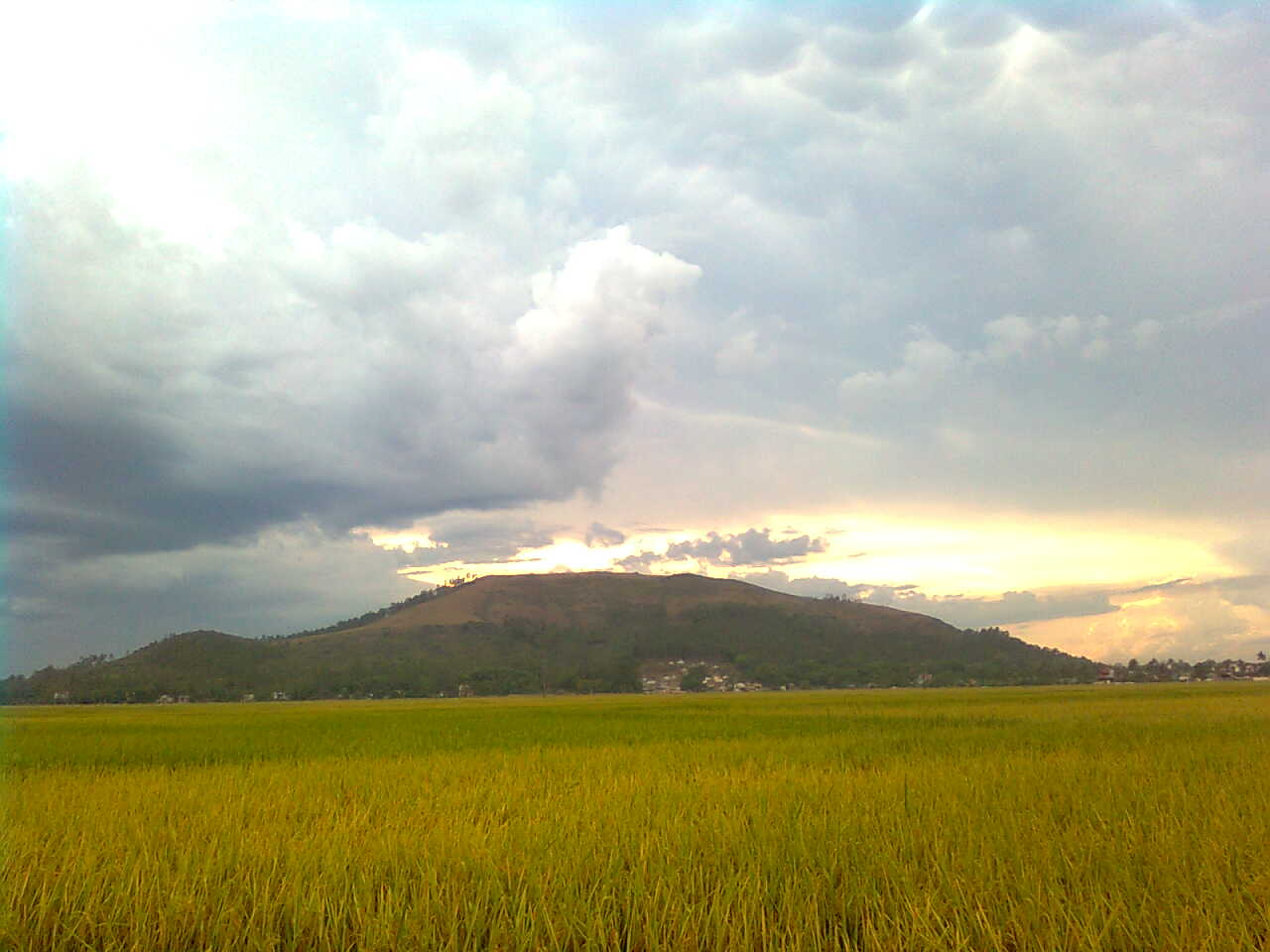
Location: Do Mountain stretches between Thieu Tan and Trieu Khanh Villages in Dong Son District, it is about 7 kilometers northwest of Thanh Hoa City.
Characteristics: Do Mountain is not only a beautiful landscape but also the exciting discovery of an ancient culture.
At the turn of the 21st century splinter stone tools can be found scattered about the mountain's surface. Experts say that some of these tools date back 300 to 400 thousand years. Primitive men left them behind. Some pieces are big and others are small. The most beautiful examples of stone axes from this vestige site are kept in the History Museum in Hanoi and the provincial museum in Thanh Hoa. This is just one example of the exciting discoveries that can be made on Do Mountain.
The mountain is situated on the right side of the Chu River, at the point where it meets the Ma River. Years ago, local people used to call the mountain, "the two sails abreast on both the Ma and Chu Rivers." Do Mountain is 158m high. Its slope ranges from 20 to 25 degrees. You can easily reach it by bicycle, motorbike, car or boat.
From a distance, Do Mountain looks like a huge black tortoise. The highest peak outlines the form of the tortoise's shell. The lower southern peak forms the head of the tortoise. An ancient Vietnamese book compares the image of the mountain to that of a tortoise playing with the water of the Chu and Ma rivers.
At the foot of the mountain, towards the west is a big rock. There are two human footprints on the rock. It is said that the footprints belonged to a giant who used to help the villagers with the construction of their houses. Unfortunately, one of the footprints has been damaged.
The ruins of King Le Duy Hop Grave (1676-1705) can be found on the eastern side of the mountain. There is also a temple dedicated to him there. Green trees surround the site. The path leading to the grave is about 2,000m long. It used to be paved with stone slabs.
Another interesting spot on the mountain is a place called "the horse saddle." The old people say that when they were young, they used to see a light that would move from east to west at night from this spot. They believe that the light came from a bright pear, worn by a horse.
At the end of the 19th century, the Can Vuong anti-French partisans used the Do Mountain as their resistance base. One can still see some traces of their existence here. There is an old stone that was used for their flagpole, a well and a kitchen.
At the foot of the Do Mountain is the Tran Village. It was established in the 14th century. The village is known for its production of mulberries and silkworms. Many of the villagers are also good masons. People from Tran Village built the King Tu Duc Tomb in Hue. Young women from the village are known for their excellent singing voices. Several of them became Kings' concubines in the past.
For the visitor with a keen eye and an acute sense of curiosity there is no place quite like Do Mountain.
It offers the visitor not only a beautiful landscape but also the exciting discovery of an ancient culture.
 Latest News
01/05/2026
When travelers think of Vietnam, names like Hanoi, Halong Bay, Hoi An, or Ho Chi Minh City often come to mind. These iconic destinations are popular for good reason. However, beyond the well-trodden routes lies another Vietnam — quieter, more authentic, and deeply connected to nature and local culture. For travelers who have already visited Vietnam or those seeking meaningful, off-the-beaten-path experiences, the country offers many lesser-known destinations that remain largely untouched by mass tourism. Here are some of Vietnam’s hidden gems worth discovering.
12/04/2025
Vietnam Airlines announced that starting May 17, 2025, all its domestic flight operations will be relocated to the newly opened Terminal T3 at Tan Son Nhat International Airport.
11/07/2025
In Vietnam, coffee is not merely a drink - it is a way of experiencing life. It is conversation, stillness, memory, rhythm, and a quite ritual that unfolds throughout the day. From the shaded sidewalks of Hanoi to the breezy riverside cafe in Saigon, coffee in Vietnam reflects the character of each region: refined, poetic, bold, and deeply personal. To travel through Vietnam is to follow the aroma of roasted beans, the whisper of coffee filters dripping slowly, and the soft clinking of glasses in morning life. Featured Tours