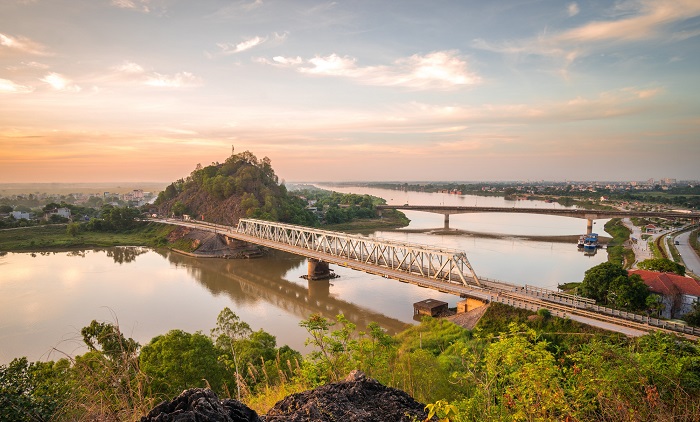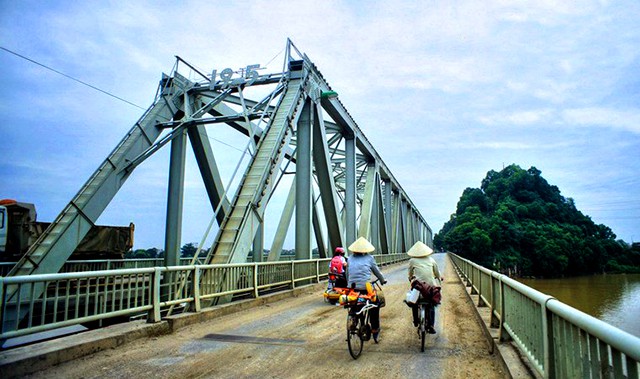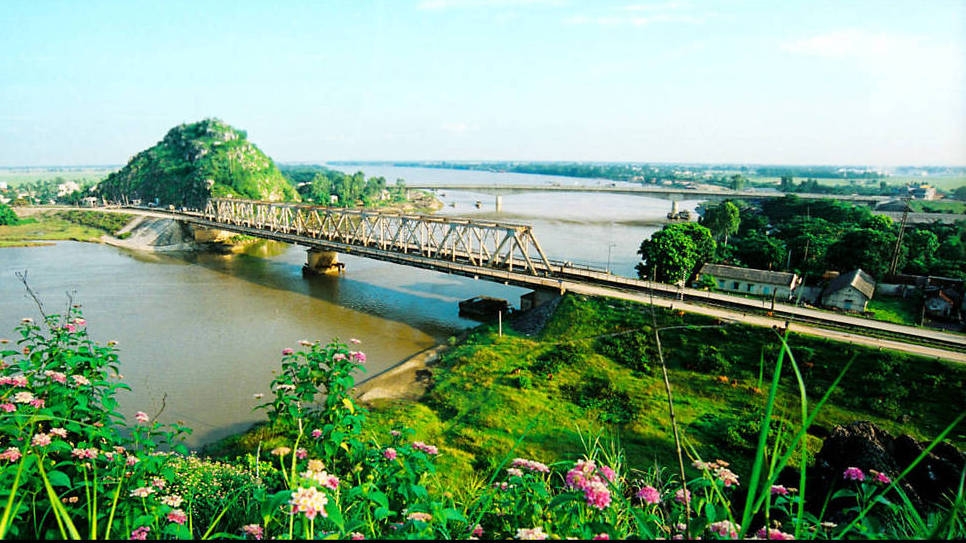
Location: Ham Rong is situated in Ham Rong Precinct, Thanh Hoa City.
Characteristics: Ham Rong literally means the dragon's jaws. The landscape actually appears in the shape of a dragon.
Ham Rong is a well-known beauty spot and historical vestige site. It is located on the National Highway No. 1A, 4km four kilometers north of the provincial town of Thanh Hoa.
In English, Ham Rong literally means the dragon's jaws and there is a good reason why this place was given the name. The landscape actually appears in the shape of a dragon. The mountain range begins in Duong Xa Commune, Dong Son District and meanders along the Ma River. It ends at the Ham Rong Bridge with an elevated peak. The range that makes up the shape has the dragon's body and the peak next to the bridge forms the dragon's head. There is a grotto that pierces through the mountain. It looks like the two eyes of the dragon, hence, its name Dragon's Eyes. The grotto has a hole on top of it and rainwater runs through this hole. The rainwater is dark brown and is called the dragon's tears. The grotto also has a round hole on the left; it has a dark green texture around it; people compare it with the dragon's eyebrows and eyelashes.
Over the centuries many great poets have been attracted to this grotto. Nguyen Trai (1380-1442), who has been recognized by UNESCO as a great man of culture, used to visit this grotto. One day he was inspired to write a beautiful poem in Chinese characters to extol the beautiful scenery. Some poems can be found inscribed on the rock. One such poem has a flowery border. King Le Thanh Tong may have written this poem in 1478.
Opposite Dragon Mountain and across Ma River is Ngoc Mountain. It has many layers of rock amassed on top of each other. The mountain's top shines a brilliant red colour in the sun like a fire blazing up from inside the earth.
Towards the southwest of Dragon Mountain, the rocks bear different shapes and have a variety of names according to their appearance. They are the five lotuses, a woman lying down, a sleeping man, two eggs, a crouching cat and the dragon's legs.
The vestige site of Dong Son in Ham Rong is known throughout the world. Archaeologists have found many artefacts of the Bronze Age here. Graves of inhabitants from that period have also supplied a wealth of artefacts. Archaeologists often use the name Dong Son to refer to the period of bronze tools.
Ham Rong area also suffered a lot during the U.S bombing, but it managed to maintain its strong character. Traces of the war can still be seen in different places with the craters and broken walls.
With all of these attributes and interesting sites, Ham Rong offers the visitor a unique chance to trace Vietnam's history from an early age.
 Latest News
01/05/2026
When travelers think of Vietnam, names like Hanoi, Halong Bay, Hoi An, or Ho Chi Minh City often come to mind. These iconic destinations are popular for good reason. However, beyond the well-trodden routes lies another Vietnam — quieter, more authentic, and deeply connected to nature and local culture. For travelers who have already visited Vietnam or those seeking meaningful, off-the-beaten-path experiences, the country offers many lesser-known destinations that remain largely untouched by mass tourism. Here are some of Vietnam’s hidden gems worth discovering.
12/04/2025
Vietnam Airlines announced that starting May 17, 2025, all its domestic flight operations will be relocated to the newly opened Terminal T3 at Tan Son Nhat International Airport.
11/07/2025
In Vietnam, coffee is not merely a drink - it is a way of experiencing life. It is conversation, stillness, memory, rhythm, and a quite ritual that unfolds throughout the day. From the shaded sidewalks of Hanoi to the breezy riverside cafe in Saigon, coffee in Vietnam reflects the character of each region: refined, poetic, bold, and deeply personal. To travel through Vietnam is to follow the aroma of roasted beans, the whisper of coffee filters dripping slowly, and the soft clinking of glasses in morning life. Featured Tours