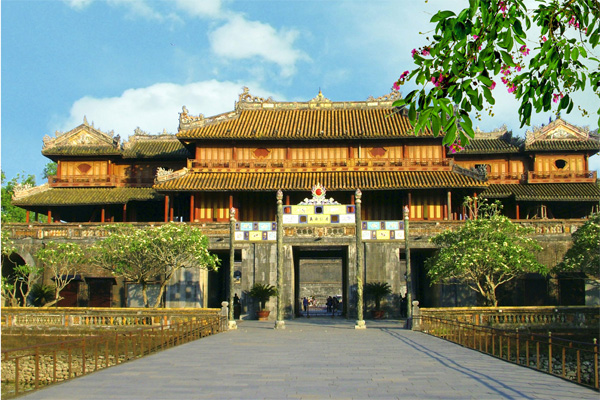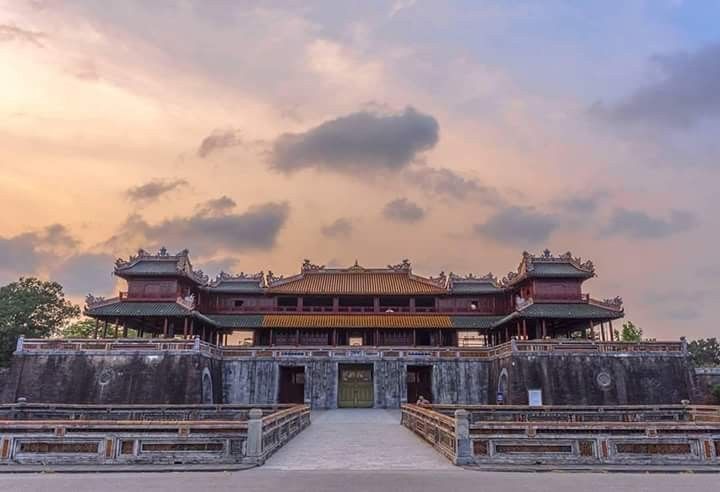
Location: Principal Gate is located in front of the Throne Palace and facing the Flag Tower.
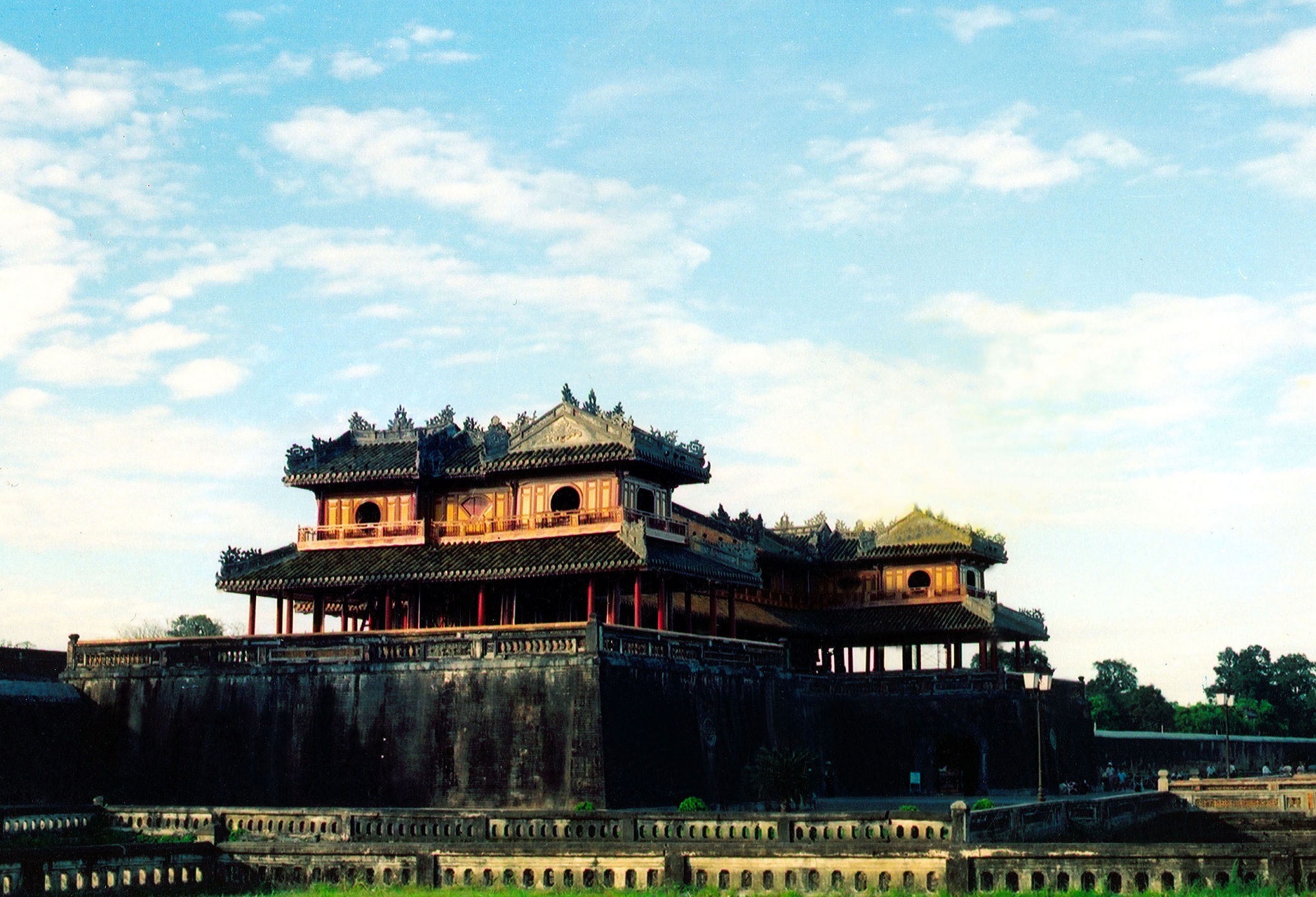
Characteristic: Ngo Mon is the main entrance to the Imperial City. Ngo Mon is a huge construction, U-shaped and consisting of two parts: below is a foundation made of brick, Thanh and Quang stone, above is a pavilion made of wood and roofed with tiles.
The longest and widest sides of this 5.2m high foundation are 50m and 27m respectively. Ascent to the top can be made by two open stone staircases on both sides. There are five entrances, the main one being Ngo Mon, paved with Thanh stone, and with red-lacquered doors reserved for the Emperor. The two side-entrances, the Left and Right Gates, were for civil and military mandarins and, inside the branches of the U, are two more gates used by soldiers, elephants, and horses on the royal procession. The upper part is the Ngu Phung Pavilion (Pavilion of Five Phoenixes) in the middle, flanked by two wing belvederes of two stories.
Viewed from above, the pavilion resembles a group of five phoenixes with beaks joining and wings widespread. They form two rows, two roofs each surrounded with a roofed gallery. The middle section of the roof is covered with yellow enameled tiles and others with dark green ones. Along the roof ridges are designs of head-turning dragons, banian leaves and bats with golden coins. Panels along the eaves are decorated with ceramic mosaics of prunes, orchid, chrysanthemum and bamboo. They are bright and harmonious, and very resistant against the rains, typhoons and the passage of time.
The upper story is supplied with wooden partitions and was exclusively reserved for the Queen Mother and the Emperor's wives. They could look through windows shaped like circles, gongs or fans, but blinds prevented them from being seen from the outside.
The lower story was left open except for the middle compartment which is paneled and supplied with glass-doors. There sat the Emperor on festive occasions. Behind his seat were a big bell and a large drum, which enhanced the importance of the ceremonies. Besides, the drum was often used to herald closing-time of the Imperial City. At this signal, sentries would fire the cannons of the Flag Tower and close, or open, the gates of the citadel. Two Chinese characters meaning "Ngo Mon" on the front of this construction had originally been gilded with genuine gold. All structural components such as partitions, columns rafters’ doors and banisters are lacquered red and yellow.
Ngo Mon was also the site where the Emperor received homage from his subjects and ceremonies took place such as: Ceremony of Proclamation of Doctor Lists (successful candidates in the national examination), Calendar Offering Day… On the side of the road passing the Ngo Mon stand two stone steles inscribed with "Tilt Your Hats and Dismount" reminding passers-by to tilt their hats and get off horses when passing this sanctum.
Ngo Mon was damaged during the wars and underwent several restorations.
 Latest News
01/05/2026
When travelers think of Vietnam, names like Hanoi, Halong Bay, Hoi An, or Ho Chi Minh City often come to mind. These iconic destinations are popular for good reason. However, beyond the well-trodden routes lies another Vietnam — quieter, more authentic, and deeply connected to nature and local culture. For travelers who have already visited Vietnam or those seeking meaningful, off-the-beaten-path experiences, the country offers many lesser-known destinations that remain largely untouched by mass tourism. Here are some of Vietnam’s hidden gems worth discovering.
12/04/2025
Vietnam Airlines announced that starting May 17, 2025, all its domestic flight operations will be relocated to the newly opened Terminal T3 at Tan Son Nhat International Airport.
11/07/2025
In Vietnam, coffee is not merely a drink - it is a way of experiencing life. It is conversation, stillness, memory, rhythm, and a quite ritual that unfolds throughout the day. From the shaded sidewalks of Hanoi to the breezy riverside cafe in Saigon, coffee in Vietnam reflects the character of each region: refined, poetic, bold, and deeply personal. To travel through Vietnam is to follow the aroma of roasted beans, the whisper of coffee filters dripping slowly, and the soft clinking of glasses in morning life. Featured Tours